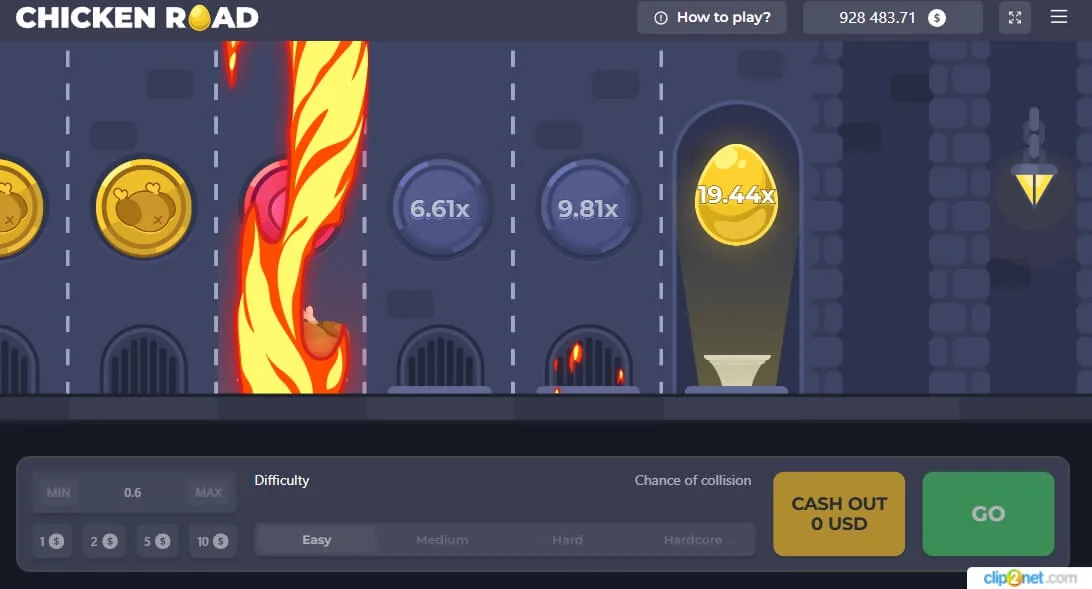
Success in any crash game hinges less on luck than on disciplined decision-making. Below we outline practical strategies for choosing your difficulty mode, timing your exits, and maintaining sensible bankroll habits. These tips apply whether you are playing at partner casinos for pennies or pushing toward that five-figure ceiling—though as always, remember that the house edge ensures losses over time, and no strategy guarantees profit.
Understanding Difficulty Modes and Their Impact
Chicken Road offers multiple difficulty tiers, each altering the frequency and volatility of crashes. Lower difficulty modes tend to produce longer runs and gentler multiplier curves, allowing more conservative players to lock in modest gains without excessive tension. Higher difficulties compress the timeline: multipliers climb faster but crash sooner and less predictably, rewarding those willing to accept frequent losses in exchange for the occasional explosive win.
Choosing a difficulty mode is not merely aesthetic. A beginner playing high difficulty will haemorrhage their bankroll through rapid, unforgiving rounds, while an experienced player stuck on easy mode will find the payout ceiling frustratingly low relative to the time invested. Match the mode to your temperament and wallet size. If you are testing the game or playing with a modest budget, start on the easiest setting to learn the rhythm. Once you are comfortable reading the multiplier's behaviour—however illusory that skill may be—you can graduate to medium or hard for the adrenaline spike and larger potential returns.
Bear in mind that difficulty does not alter the underlying return-to-player figure in a meaningful way; it redistributes risk. Easy mode spreads small wins across many rounds, whilst hard mode concentrates payouts into rare spikes. Neither is 'better'—they simply serve different appetites for variance.
Cash-Out Timing: When to Take Profit
The central dilemma in Chicken Road, as in all crash games, is deciding when to cash out. Wait too long and the round crashes, erasing your stake; bail too early and you watch the multiplier soar without you. There is no algorithm that can predict the crash point—despite what some forum posts claim—because the outcome is determined by a random-number generator at the start of each round. What you can control is your exit strategy.
A common approach is the fixed-target method: decide in advance that you will cash out at, say, 2× or 3×, and stick to that rule regardless of what the multiplier does. This discipline prevents emotional chasing and ensures you walk away with consistent, if modest, gains on winning rounds. The downside is that you will never capture those exhilarating 10× or 20× runs, but you also avoid the crushing feeling of watching a sure win evaporate at the last second.
Alternatively, some players use a tiered system: cash out half their position at 2×, then let the remainder ride to 5× or beyond. This hybrid strategy locks in a baseline profit whilst leaving room for a lucky streak. The trade-off is added complexity—you must place two bets or use the partial cash-out feature if the game supports it. For high-difficulty modes, where crashes arrive with little warning, the tiered approach can feel more like a gamble than a strategy.
- Set a fixed cash-out target (e.g. 2× or 3×) before each session and honour it strictly.
- Use a tiered exit: secure half at 2×, then let the rest chase higher multipliers.
- Avoid chasing losses by raising your target after a crash—that is a fast route to ruin.
- Watch the game for a few rounds without betting to get a feel for the current volatility, though past rounds reveal nothing about future outcomes.
Bankroll Management and Stake Sizing
No strategy matters if you exhaust your funds in the first ten minutes. Bankroll management in Chicken Road means dividing your total budget into units small enough to survive a realistic losing streak. A sensible rule of thumb is to risk no more than 1–2 per cent of your session bankroll on a single round. If you have £100 to play with, that translates to stakes of £1–£2 per bet. This cushion lets you endure twenty or more consecutive losses—an entirely plausible scenario in high-difficulty mode—without going bust.
Resist the temptation to increase your stake after a loss in an attempt to recover quickly. This Martingale-style behaviour amplifies risk exponentially and can wipe out your bankroll in a handful of rounds. Conversely, after a big win it is wise to pocket a portion of the profit rather than rolling it all back into play. Many experienced players withdraw 50 per cent of any windfall above a certain threshold, treating it as locked profit rather than fresh chips.
Finally, set a stop-loss and a win target for each session. If you lose 30 per cent of your starting bankroll, walk away; if you double it, consider cashing out entirely or banking half and playing with house money. These arbitrary lines prevent the slow bleed that turns a fun session into a regrettable one.
Advanced Tactics: Auto Cash-Out and Pattern Watching
Most partner casinos hosting Chicken Road offer an auto cash-out feature, which lets you pre-set an exit multiplier. This removes the human hesitation factor—no second-guessing, no last-second panic clicks. For players who struggle with impulse control or who want to enforce a strict strategy, auto cash-out is invaluable. Set it to your target (say, 2.5×) and let the system execute without emotion.
Some players swear by pattern watching: noting sequences of low or high crashes and adjusting bets accordingly. The uncomfortable truth is that each round is independent, and past results have zero predictive power. The random-number generator does not 'remember' the last ten crashes, nor does it owe you a high multiplier after a string of early busts. Pattern watching can be entertaining, even meditative, but it should never dictate your stake size or cash-out timing. Treat it as superstition, not strategy.
A more rational tactic is session pacing. If you are on a cold streak—say, five crashes in a row before 2×—consider dropping your difficulty mode or taking a break. Variance is inevitable, but fatigue and frustration lead to poor decisions. Conversely, if you are riding a hot streak, banking some profit and continuing with a smaller stake preserves your gains whilst keeping the fun alive.
Risk Control and Responsible Play
Chicken Road's £20,000 maximum win is tantalising, but reaching it requires either enormous stakes or a once-in-a-lifetime multiplier sequence. The vast majority of sessions will end in a net loss, because crash games—like all casino products—are designed with a house edge. Accept this reality before you place your first bet. If you are playing to make money rather than for entertainment, you are setting yourself up for disappointment.
Set deposit limits through your casino account and never gamble with money earmarked for essentials. Chicken Road can be thrilling in short bursts, but marathon sessions invite careless decisions and mounting losses. Take regular breaks, hydrate, and remember that the game will still be there tomorrow. If you find yourself chasing losses, lying about your play, or feeling anxious when not gambling, seek support from organisations such as GamCare or BeGambleAware. This is entertainment for adults aged 18 and over, and it should remain exactly that: a diversion, not a dependence.
Frequently asked questions
Can I predict when Chicken Road will crash?
No. Each round's outcome is determined by a random-number generator at the start, making the crash point genuinely unpredictable. Pattern watching and betting systems do not change the odds.
What is the best difficulty mode for beginners?
Start on the easiest setting to learn the game's rhythm and practise cash-out timing without burning through your bankroll. Once comfortable, experiment with higher difficulties for increased volatility.
How much of my bankroll should I bet per round?
Risk no more than 1–2 per cent of your total session budget per bet. This cushion helps you survive losing streaks and prevents rapid bankroll depletion.